There’s a famous adage: “We don’t know what we have till it’s gone.” We take our senses for granted but when COVID-19 struck we got a much-needed awakening! A good percentage of the population realised, among other things, the significance of smell in their everyday lives. I saw this firsthand in my family, what has been termed as “anosmia”, or the loss of smell. According to studies, 8 out of 10 people who tested positive for the virus suffered from anosmia. This hinders us from enjoying the everyday pleasures of life, like the smell of earth after the first rains or the warm welcome of a new book. It also has repercussions on our everyday survival since smell plays a crucial role in helping us determine the edibility of food; it also prevents us from detecting danger if we can’t smell the leak from a gas cylinder or the smoke from a fire. Hans Laube employed this connection between smell and thought/mind in his invention that he called “smell-o-vision”: different odours were sprayed during the screening of the movie The Scent of Mystery (1960) so that viewers would create a relation between the smells and what was happening on the screen. This relation is also evident in Indian rituals, practices of Ayurveda, and other household customs that are meant to help with mental well-being, curing diseases, etc. that have been present since ancient times. These instances make us realise how important smell is in our everyday lives.
The sense of smell is actually odour-related information carried by different molecules from our nose to the brain. When we smell something, the volatile molecules reach all the way to the roof of our nasal cavity. The nasal mucus then takes up these molecules and absorbs them. This, in turn, is processed by the neurons of the brain. As a result, we can picture the unique smell of the circumstance.
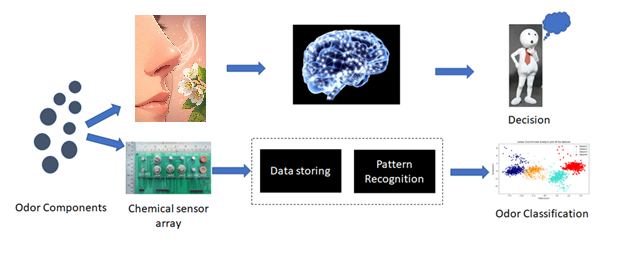
The above figure illustrates the possibility of imitating the brain’s capability to distinguish between different odours using electronic means i.e., an electronic nose. To characterize this special sensory phenomenon using an electronic nose, the following factors need to be addressed:
- An electronic sensor array is needed to imitate the human nose. The molecules or chemicals carrying the information of smell must be trapped or captured by means of the sensor array.
- To replicate the human brain:
- A data collection unit must be designed for storing the data in a Personal Computer for further processing.
- Characteristic features of various types of odours can be extracted using computer-based pattern recognition techniques and Artificial Neural Networks.
- A data collection unit must be designed for storing the data in a Personal Computer for further processing.
- Generally, the odours can be classified into two main groups called scent (we call it good smell) and stench (negative or rejectable smell). We can generally infer whether a room has a nice or unpleasant smell when we suddenly enter it. However, after spending some time there, we lose the ability to detect the smells present in that room. The same thing happens to electronic sensors as well. This is technically called sensor fatigue. The chamber containing the sensors of the electronic nose needs to be purged after every instance of data collection. This allows the sensors to recover their original state after taking the readings.
In the last few decades, gas sensing technology has improved significantly. The development of gas sensing methods has mostly concentrated on tackling common problems in fields such as food & agriculture, human disease detection, environmental parameter monitoring, safety & security, etc. Research groups across the world have been working on different technologies for devising gas sensors including electrical conductivity, electrochemical, optical, MOSFET, piezoelectric, MOS (Metal Oxide Semiconductor), etc. The advancement in data analysis methods based on pattern recognition algorithms has also helped researchers to achieve pattern-rich information from the collected sensors’ data.
Orange is a commonly grown citrus fruit in India. It occupies nearly 40% of the total area under citrus cultivation. Orange contains vitamins A, B, C, and phosphorus, which are crucial for overall nutritional well-being. It is the main source of peel oil, citric acid, and cosmetics which have very good international market value. There are different kinds of biotic and abiotic stresses that affect the productivity of plants including disease, insect attack, moisture & nutrient imbalance, herbivore attack, etc. Our research group has developed several electronic nose systems that, up until this point, have been able to diagnose different health conditions of orange plants induced by stresses such as water stress, salt stress, and infection caused by the Citrus Tristeza virus.
Plants signal their health condition by emitting different hydrocarbons named volatile organic compounds. These are trapped or captured by the gas sensors when encountered. The sensors respond to these volatile organic compound profiles and provide an electrical signal as a fingerprint based on the composition of this pattern. These electrical signals are later analysed for classification with the help of an Artificial Neural Network or other pattern recognition methods.
Before the development of the electronic nose, the gas flow inside the gas sensor chamber is simulated with the help of Computational Fluid Dynamics (CFD) to get preliminary information related to the sensor response. This helps in estimating the mass flow rate and fluid pressure that will be generated over the sensor heads when the flowing fluid passes through the sensors. However, the sensitivity and selectivity of MOS-based sensors vary with respect to the temperature applied to the gas-sensitive surface. Hence, instead of providing a constant DC voltage, an intermittent voltage signal is applied to the heater terminals of the gas sensors. The process of supplying such a signal to control the heater voltage is called temperature modulation. The selectivity and sensitivity of MOS-based gas sensors can be altered according to our needs using temperature modulation. For this purpose, a Pulse Width Modulated signal of a certain frequency produced by a microcontroller can be fed to the heater terminals of each gas sensor. Our findings in this field have been published in five different journals and at a few conferences. Two recent studies done using our electronic nose system are currently under review in two journals.
The technique of using an electronic olfactory device for agricultural-based applications has a significant impact on the early detection of plant health so that a number of preventative measures can be carried out. Nowadays, people want to use their smartphones to view real-time data, which is where the Internet of Things (IoT) comes into play. An IoT- enabled electronic nose can be used by farmers and other agricultural professionals to remotely monitor the health of their crops. We are motivated to go further and conduct research to identify many other plant stresses by this technique in tracking numerous agricultural issues. By meeting the demands of the increasing global population, a smart hand-held device with IoT capabilities and pre-installed pattern recognition algorithms will enable the user to considerably boost agricultural production at a very low cost (less than ₹ 10,000). However, the same hand-held device can be customized for food quality monitoring also. By customizing the pre-installed pattern recognition methods, the parameters like quality of food, adulterations as well as counterfeiting of food, etc. can also be monitored.